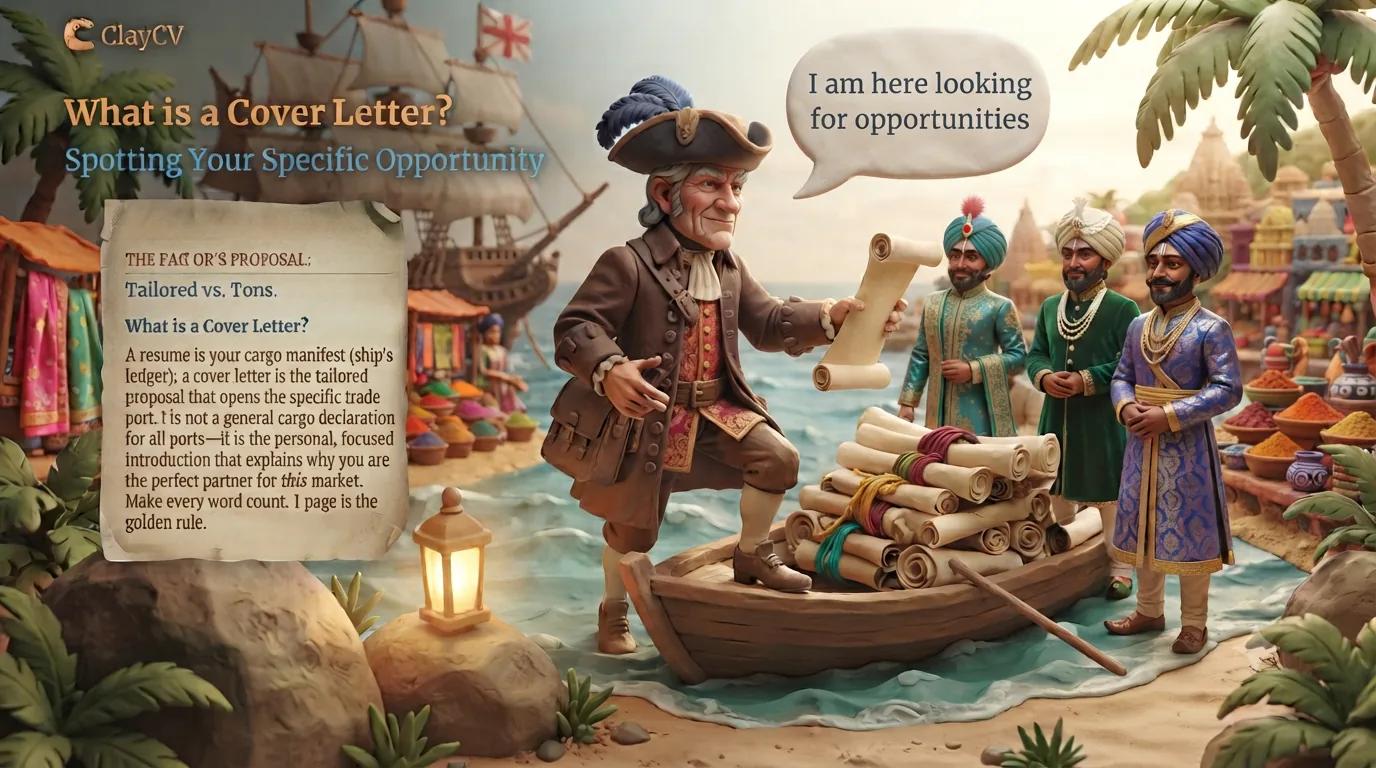
What is a cover letter? It's a short letter you send with your resume to explain why you want a particular job and why you're a good fit for it. Your resume lists what you have done. The cover letter picks the two or three parts of that record that matter most for this role and tells the employer why.
What is a cover letter?
A cover letter is a one-to-one business letter from a job applicant to an employer. It usually runs to three or four short paragraphs and sits on a single page. For word ranges and the few cases where a letter can run longer, see how many words to aim for. You either upload it as a file next to your resume or paste it into the body of an email or an application form.
The name comes from paper applications. The letter was the "cover" sheet on top of the resume and told the reader what was enclosed and why. Most applications are digital now, and the letter still introduces you and makes the case for an interview.
Covering letter, application letter and motivation letter all mean the same thing.
What is the purpose of a cover letter?
Hiring managers skim a resume, but they read a cover letter in sentences, so the letter can do three things a resume can't:
- Link your experience to this job. Pick two or three requirements and point to proof for each.
- Explain what a resume can't. A career change, a gap or a referral needs a sentence, not a bullet.
- Show how you write. Clear, specific sentences with no mistakes are evidence on their own.
Linking your experience to this job
A resume is mostly the same for every application in your field. The letter is where you show that you read this job ad. Pick the two or three requirements that matter most to the employer, then point to the moment in your work history that proves you can meet each one.
Explaining what a resume can't
Some parts of your story don't fit into bullet points:
- a change of career, and why your old skills carry over
- a gap in employment and what you did during it
- a move to a new city and when you can start
- a referral from someone who already works there
- the reason you want this employer in particular
Showing how you write
Almost every job involves writing emails, reports or messages to customers. Your letter is the first sample of that writing the employer sees. Clear, specific sentences with no mistakes tell them more than any line on a resume that says "strong communication skills".
What is a cover letter for a resume?
People ask what a cover letter is "for a resume" because the two documents are almost always sent together.
| Resume | Cover letter | |
|---|---|---|
| Answers | "What have you done?" | "Why you, for this job?" |
| Covers | Your whole work history, education and skills | Two or three achievements that fit this job |
| Written for | Most jobs in your field, with small edits | One job and one employer |
| Format | Headings and bullet points | Three or four short paragraphs |
| Voice | Short phrases, usually without "I" | First person, full sentences |
| How it's read | Skimmed for titles, dates and results | Read in sentences, start to finish |
Never repeat your resume line by line in the letter. Choose one or two achievements from it and add the context that a bullet point leaves out: the problem, what you did, and why it matters to this employer.
If you're still building the resume itself, start from a template and come back to the letter once the content is settled. It's easier to pick your strongest examples when you can see them all in one place.
What should a cover letter include?
Every cover letter has the same six parts, in the same order. Hiring managers expect this layout, so keep it and spend your effort on what goes inside it.
- Header: your name, phone number, email and city, plus the date. In a paper or PDF letter, add the employer's name and address below yours. In an email, your details move to the signature.
- Greeting: use the hiring manager's name if you can find it in the job ad, on the company website or on LinkedIn. "Dear Hiring Manager" is a safe fallback when no name is listed.
- Opening paragraph: name the job you are applying for and give one specific reason you are a strong match. Skip "I am writing to apply for". The reader already knows that.
- Body: one or two paragraphs that connect your experience to the job's main needs. Use a real example with a result for each one.
- Closing paragraph: say what you would like to happen next, usually a conversation, and thank the reader for their time.
- Sign-off: "Kind regards" or "Sincerely", followed by your full name.
Formatting a cover letter
Keep the format plain so the reader notices your words. These settings suit almost any job:
| Setting | What to use |
|---|---|
| Font | The same font as your resume, at 10.5 to 12 points |
| Margins | About 1 inch (2.5 cm) on every side |
| Spacing | Single-spaced paragraphs with a blank line between them |
| Alignment | Left-aligned text with no columns, tables or graphics |
| File type | PDF, unless the employer asks for a Word document |
| File name | A clear name, such as maya-patel-cover-letter.pdf |
Using the same header and font as your resume makes the two pages look like one application. In an email, leave out the address block and start with the greeting. Put the job title in the subject line so the message reaches the right person.
What does a cover letter look like? An annotated example
Here is a complete letter for a customer support role. The applicant, employer and figures are illustrative, but the structure is what you would send. Turn on the notes to see which part is which.
Maya Patel
Columbus, OH | maya.patel@email.com | (614) 555-0142
November 12, 2026
Dear Ms. Okafor,
I'd like to apply for the Customer Support Specialist role at Fernway Home. In three years on the help desk at Oakmere Furniture, I cut our average reply time from nine hours to under three, and I'd like to bring that same focus to your team.
Your posting asks for someone who can handle delivery problems calmly and keep customers informed. At Oakmere, I ran the queue for late and damaged orders, which was about 40 cases a day during sale periods. I wrote a set of reply templates for the most common problems and shared them with the team. That change is a big part of why our customer satisfaction score rose from 82% to 91% over the year.
I also noticed that Fernway offers same-day delivery in three cities. That means problems need fixing fast, and I enjoy that kind of pressure. I'm comfortable in Zendesk and Shopify, which I see you use.
I'd welcome the chance to talk about how I could help your support team. Thank you for your time.
Kind regards,
Maya Patel
Why this letter works:
- DoThe opening names the role and gives a result in the first two sentences.
- DoThe body quotes the posting ("handle delivery problems calmly") and backs it with a real duty and a number.
- DoOne paragraph is only about the employer. Same-day delivery shows Maya read about Fernway, and she says why that suits her.
- DoThe close asks for a conversation and stops.
The letter also leaves out a list of every past job, hobbies, and claims like "I am a hard worker" with nothing to back them. For more letters by job and situation, browse our cover letter examples.
When do you need a cover letter?
Send one whenever the application asks for it. When it is marked optional, send one anyway. An optional letter is a chance to stand out from the applicants who skip it, and it takes little extra time once your resume is done.
A cover letter matters most in these cases:
- Changing careers, when your resume alone doesn't show why you fit.
- A referral or a personal link to the company.
- Roles with a lot of writing or client contact, where the letter is a writing sample.
- Small companies, where one person often reads every application.
- Internships and first jobs, when you have little experience to show.
- Email applications, where the email itself can be your cover letter. Keep the same structure and attach your resume.
For letters written for two of these cases, see this career change cover letter and this internship cover letter.
You can leave it out when the ad says not to send one, or when the form asks short written questions instead. Those answers do the same job, so give them the same effort.
Common cover letter mistakes
Most weak letters fail in the same few ways:
Mistake
Repeating the resume
A paragraph that could be a list of your past duties.
Instead
Cut it and pick one example to explain in depth.
Mistake
Writing one letter for every job
A letter you could send to ten employers by changing the company name.
Instead
Mention one thing about this employer that you could only know from reading about them.
Mistake
Talking only about what you want
"This role would help me grow" tells the employer about your goals.
Instead
Write about what you can do for them, then mention why the role appeals to you.
Mistake
Making claims without proof
"Excellent attention to detail" means little on its own.
Instead
A letter with no typos and one example of catching a costly error.
Mistake
Getting names wrong
The company name, the job title or the hiring manager's name.
Instead
Check all three twice before you send.
How to write your first cover letter
Your first letter comes together faster in this order:
- Open the job ad next to your resume.
- Underline the three requirements that appear most often or come first.
- For each one, find a single example from your work, studies or volunteering that shows you meeting it. Those examples become your body paragraphs.
- Write the opening last. Once you know your strongest example, it is easy to put it in the first two sentences.
Our cover letter templates give you the layout in a design that matches your resume. If you want a first draft to edit, the cover letter generator writes one from your resume and the job ad, and you can then add your own detail.