How long should a resume be? For most people, one page early in a career and two pages once there is more relevant work to show. Three pages or more is only normal for an academic or medical CV. The right length is the shortest one that still shows everything the job asks for.
Whatever the total, a recruiter reads page one first, so that page has to make your case on its own. Every line after it should give the reader something the job asks for.
How long should a resume be by career stage?
If you're asking how many pages should a resume be for your stage, your years of relevant experience are the best guide. These ranges match what most hiring guides recommend:
| Career stage | Recommended length | How far back to go |
|---|---|---|
| Student or new graduate | 1 page | Internships, projects and part-time work that fit the job |
| Up to 5 years of work | 1 page, 2 only if the extra work fits the job | All relevant jobs |
| 5 to 15 years | 1 or 2 pages | All relevant jobs, with early ones shortened |
| 15 years or more, or senior roles | 2 pages | The last 10 to 15 years in full, older roles on one line |
| Career changer | 1 page | Skills and projects that fit the new field, then past jobs briefly |
Years alone don't decide it. A nurse with four years of work who has moved through three wards and earned two certifications may fill two pages with relevant detail. A manager with twelve years in one role may say it all on one. Count only the work that fits this job.
Should a resume be one page?
A resume should be one page when one page holds everything the job needs. For students, graduates and anyone with a few years of work, it nearly always does.
On one page the reader sees your whole case at once, and you're forced to keep only your strongest lines.
Early in a career, a resume that runs onto a second page usually carries filler. Look for a long objective, full course lists, duties copied from a job description, or a references line.
Objective: Seeking a challenging role where I can grow my skills and contribute to a dynamic team.
Relevant coursework: Marketing 101, Statistics, Business Writing, Economics, Psychology, Accounting
Why it doesn’t work
Neither line tells the reader what you can do. Together they take three lines that a project or internship could use.
Capstone project: brand campaign for a local café
Planned and ran a six-week Instagram campaign that grew the café's followers from 300 to 1,100.
Why it works
It shows a skill the job asks for, with a result the reader can ask you about in an interview.
The one-page rule is a habit, though, not a requirement, unless a job ad sets a page limit. Ten years crammed onto one page with tiny text and no margins reads worse than a clean second page.
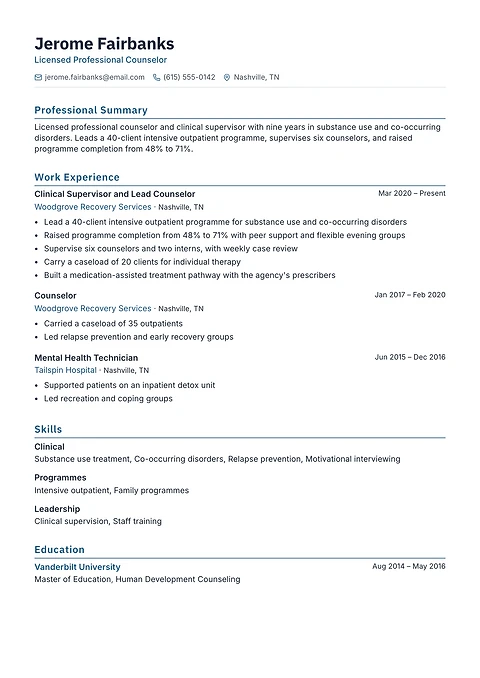
Resume example
Nine years of work on one page: three jobs, grouped skills and education, with normal margins and text size. The person and content are illustrative.
Use this templateCan a resume be 2 pages?
Yes. A resume can be 2 pages when the second page holds work the job needs. Use this test: page two should carry at least half a page of relevant content.
If it holds only a few lines, cut back to one page. If it would hold half a page or more, use both pages fully. That makes a page and a half fine, as long as the half is relevant.
A two-page resume needs a little extra care:
- DoPut your strongest material on page one. Your most recent and relevant jobs go there, along with your introduction and skills.
- DoAdd your name and a page number at the top or bottom of page two, in case the pages are printed and separated.
- Don’tSplit one job's bullets across the break. Move the whole entry to page two instead.
- Don’tLeave page two mostly empty. A second page that is a third full looks like an accident.
Length doesn't count against you in the software many employers use to collect applications. It reads every page. Page count matters to the person who reads the resume next.
When a resume can be longer than two pages
Three pages or more is the exception. It fits a few cases:
- Academic and research jobs, which ask for a CV that lists publications, grants, teaching and talks. A CV grows with your career and can run to many pages.
- Medical and scientific roles that expect the same kind of full CV.
- Some senior executive roles, where the employer asks for a detailed record of boards, deals or major programmes.
US federal jobs are no longer on that list.
Outside these cases, a resume of three pages or more is usually too long. The reader has to search for what matters, and the newest work gets lost among older jobs.
Country matters a little too. In the UK, Ireland, Australia and New Zealand, the document is often called a CV even for ordinary jobs, and two pages is the usual length there. When a job ad gives a page limit, follow it over any general rule.
How to cut a resume to fit
Most resumes that run long carry the same kinds of extra lines. Cut them in this order, from the least useful to the most:
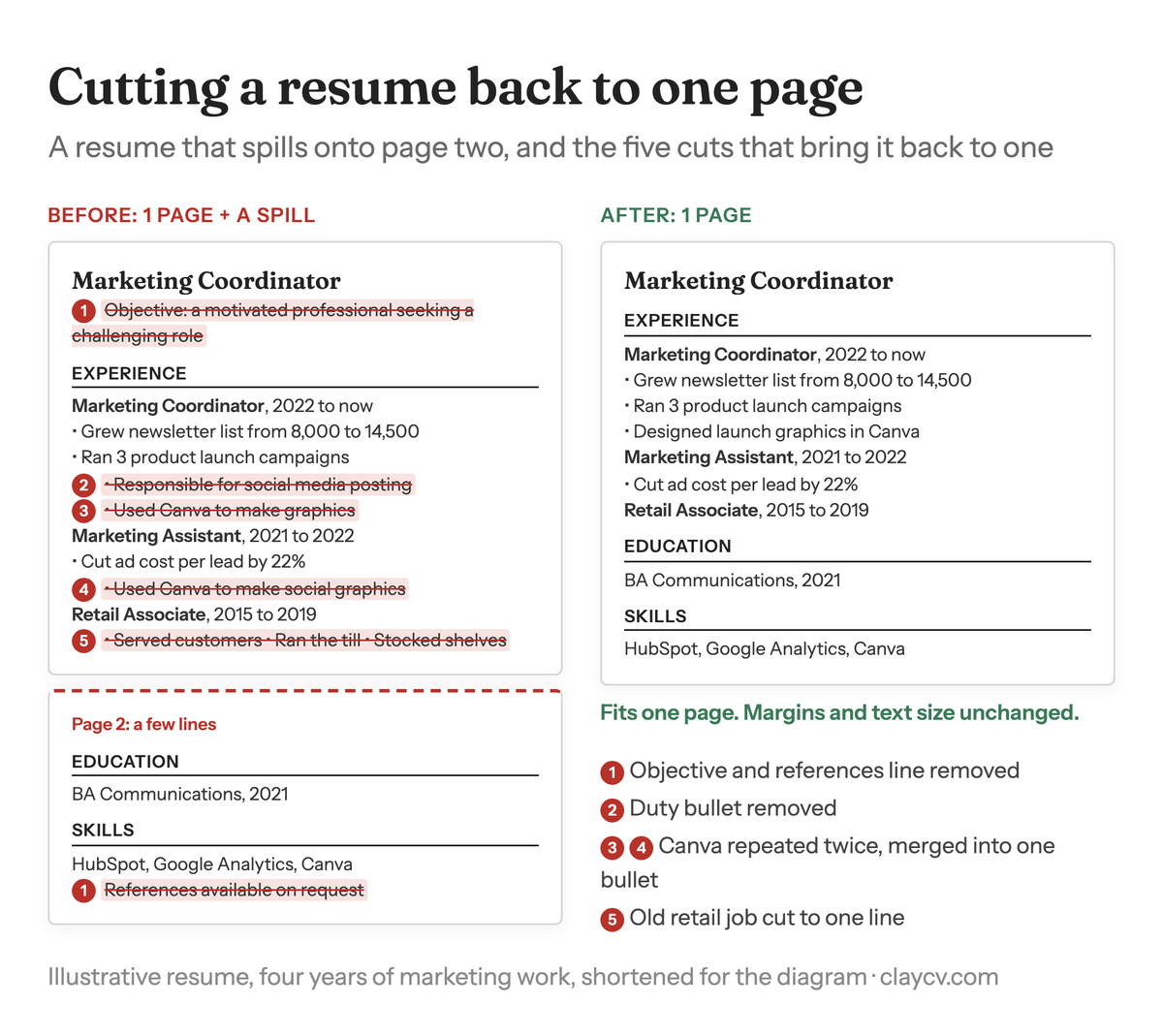
- Cut1. Lines that do no work: an objective statement, "References available on request", a second address, a photo where photos aren't expected.
- Cut2. Old jobs: anything older than 10 to 15 years shrinks to one line with the title, employer and dates, or goes.
- Cut3. Duty bullets: lines that say what the job was ("Responsible for scheduling") rather than what you did with it.
- Cut4. Repeats: the same skill described in three jobs. Keep the strongest version.
- Cut5. Long bullets: trim each to 2 lines at most.
- KeepResults and numbers, even in older jobs you shorten.
- KeepSkills the job ad names, wherever they appear.
- KeepYour most recent relevant job, in full, on page one.
Responsible for scheduling social media posts for the company's accounts.
Why it doesn’t work
It names a duty and stops there. Anyone in the role could have written it.
Planned 60 posts a month across three channels and raised average engagement by 25% in six months.
Why it works
It says what you did and what changed, and it still fits in 2 lines.
Formatting comes last. Narrow margins and small text can pull a resume onto one page, but they make it harder to read. Keep margins between half an inch and one inch, and keep body text at a size that's easy to read when printed.
Here is what that order does to one resume that runs a few lines onto page two. None of the cuts touches a result or a skill the job asked for. The applicant and the lines are illustrative.
For the skills section, this guide to skills for a resume shows how to keep it to six to twelve items.
How far back should a resume go?
About 10 to 15 years of work is enough for most jobs. You don't need to list every job you've had. Older roles rarely change a hiring decision, and they push your recent work down the page.
There are two exceptions. Keep an older job if it is the only place you did the work this job needs. And keep the employer name for a well-known older role, even as a single line, if it helps the reader place you.
Sales assistant, City Books, 2012 to 2014
Why it works
The reader still sees the employer and the dates, and the job costs one line instead of five.
Education works the same way. Once you have a few years of work, your degree needs only the name, the school and the year, or no year at all. Drop school grades, clubs and course lists once you have a few jobs to show.
How long should a resume be in words?
Page count depends on layout, so a word count is a useful second check. The same text can fill one page in a compact two-column design and spill onto two in a single column with wide spacing. Words tell you how much you've written.
The resume checker flags a resume with fewer than 300 words as thin and one with more than 1,400 as long. It also flags three pages or more. And it flags a two-page resume from someone with under five years of work and under 800 words, because that usually means short content spaced out to fill the page.
Under 300 words
Flagged as thin
300 to 1,400 words
No flag
Over 1,400 words
Flagged as long
Length should match the job you apply for. You might keep two versions: one page for most applications and two pages for senior roles that ask for more detail.
Cover letters follow a tighter rule. If you're writing one too, see how long should a cover letter be.
How to check your resume length before you apply
Run these checks on the final file, not the draft in your editor:
- Open the PDF and count the pages. Editors and PDFs don't always break pages in the same place.
- Check page two is at least half full of relevant content, if there is one.
- Check page one holds your introduction, skills and most recent relevant job.
- Look at the oldest job on the page and ask whether it helps with this application.
- Read every bullet on page two and ask whether you would miss it if it were gone.
If you're starting over or the layout is fighting you, start from a template built to fit one or two pages cleanly.