What is a resume summary? It's a short paragraph at the top of your resume that tells the reader who you are, what you've achieved and what you bring to this job. It sits right under your name and contact details, so it's often the first thing a recruiter reads.
Advice on the details varies a lot. One page says one sentence, another says five bullet points, and they disagree on whether to write "I". The rules below are the ones ClayCV's own summary generator and resume checker work to, each with its reason.
What is a resume summary?
A resume summary has three parts: what you do and for how long, proof that you do it well, and what you'd bring to this job. Recruiters read it to decide whether the rest of the page is worth a closer look.
Professional summary, resume profile, summary statement and summary of qualifications all mean the same thing. Use whichever heading your template has. "Professional Summary" and "Summary" are the most common.
Your experience section still carries the detail. The summary picks the two or three facts that matter most for this job and puts them where they'll be read first.
What goes in a professional summary for a resume
Each sentence has one job. Here is a summary built from the resume of Alex Moreno, a marketing coordinator applying for an email marketing role. Alex, the employer and the figures are illustrative.
Marketing coordinator with four years at Fernhill Outdoor, an online retailer, running email campaigns and the social calendar for a list of 60,000 customers.
[2 · Your best proof, with a number] Rebuilt the welcome email series in Klaviyo, which lifted first-order conversion from 3% to 5% in six months.
[3 · What you bring to this job] Brings A/B testing, list segmentation and copywriting to an email-led team.
Each sentence comes from a different part of the resume:
- The first sentence comes from your job title, years and the scale of the work. "A list of 60,000 customers" tells the reader more than "a large audience".
- The second sentence is your strongest bullet point, shortened. Pick the one closest to what the job ad cares about.
- The third sentence uses the job ad's own words. This ad asked for "A/B testing" and "segmentation", so those are the words Alex uses.
If your experience bullets are weak, fix them first. A bullet point writer can turn duties into results to work from. A summary can only be as strong as the results behind it.
How long a resume summary should be
Two to four sentences, about 40 to 80 words. That's long enough to give a title, a result and a reason to read on, and short enough to scan in a few seconds.
| ClayCV's rule | Why | |
|---|---|---|
| Sentences | 2 to 4 | One sentence rarely fits a title and a result. Five starts to repeat your experience section. |
| Words | 40 to 80 | Our summary generator writes to this range. |
| Upper limit | 90 words | Our resume checker flags a summary longer than this. |
| Format | One short paragraph | Bullet points under a summary heading read like a second skills list. |
| Voice | No "I" or "my" | Resumes are written in short, implied first person. Third person ("Alex is") reads as if someone else wrote it. |
If you have more than one great result, keep the one that fits the job best. The others belong in your experience section, where they have room. A resume checker flags a summary that runs long, along with other common problems.
Where the professional summary goes on a resume
Directly under your name and contact details, above your experience. It's the first section of the page, so it's what the reader sees before deciding to keep going.
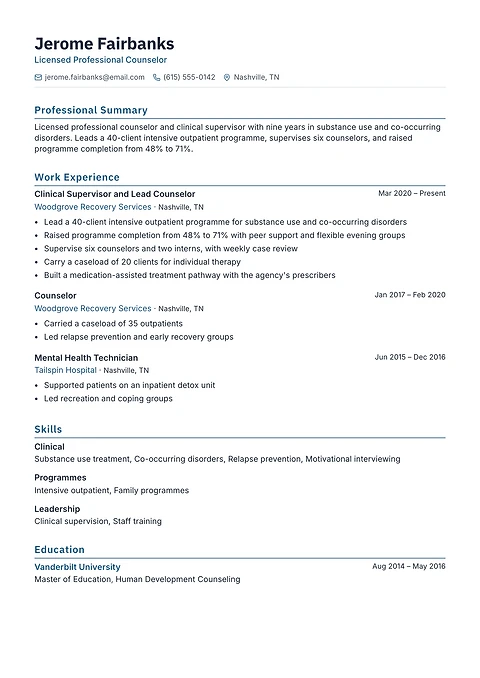
Resume example
The summary sits under the header and above work experience: three lines that name the role, the years and one result with a number. The person and content are illustrative.
Use this templateA few cases change that:
- DoKeep it at the top in almost every resume, whatever your level.
- DoShorten it to two sentences if your page is full and you need room for experience. See [how many pages to aim for](/blog/how-long-should-a-resume-be).
- Don’tDon't put it in a side column where it reads like a caption. If your template has two columns, use the main one.
- Don’tDon't add one on a CV for academic jobs if the field expects publications and teaching first. Follow the job ad.
Resume summary vs objective
A resume objective is a sentence about the job you want. A resume summary is about what you've done and what you'll bring. Objectives were the norm in older resumes. Today a summary is the better choice, because it answers the question the reader has: why this person?
Here's the same person written both ways:
Objective
About what you want
- "Seeking a challenging marketing role where I can use my skills and grow with a dynamic company."
- Says nothing the reader can check
- Could be on anyone's resume
Summary
About what you bring
- "Marketing coordinator with four years at an online retailer. Lifted first-order conversion from 3% to 5% with a rebuilt welcome series."
- Gives a title, a number and a timeframe
- Belongs only to this applicant
When does an objective on a resume still make sense? When the reader can't tell from your experience what job you're aiming for. Career changers, students and people returning to work are the usual cases. Even then, you don't need a separate objective statement. Write a summary and let the last sentence name the target, like "Moving into UX research after five years in customer support."
Tailor your summary to each job ad
The same experience can lead with different facts. Here is Alex's summary rewritten for two different ads. Both are illustrative.
| Ad A: Email Marketing Specialist | Ad B: Social Media Manager | |
|---|---|---|
| The ad asks for | A/B testing, segmentation, Klaviyo | Short-form video, community management, growth |
| Sentence 1 | Marketing coordinator with four years at an online retailer, running email campaigns and the social calendar for a list of 60,000 customers. | Marketing coordinator with four years at an online retailer, running the social calendar and email campaigns for a growing online store. |
| Sentence 2 | Rebuilt the welcome email series in Klaviyo, lifting first-order conversion from 3% to 5%. | Grew Instagram followers from 8,000 to 21,000 in two years with weekly Reels and creator partnerships. |
| Sentence 3 | Brings A/B testing, list segmentation and copywriting to an email-led team. | Brings content planning, short-form video and community management to a social-first team. |
The job title and years stay the same. What changes is the order of the work, the result in the middle and the words in the last line. That takes a few minutes per application and makes the top of the page match what the reader is looking for. To find the terms to use, a keyword scanner lists what the ad asks for and where your resume shows it.
A weak summary fixed line by line
Here's a generic summary built from stock phrases:
Hard-working, results-driven marketing professional with excellent communication skills and a passion for creativity. Proven track record of success in fast-paced environments. Seeking an opportunity to leverage my skills to contribute to a forward-thinking company.
Why it doesn’t work
Every line could belong to anyone. There's no job title, no number and no sign of what the applicant has done.
Here's what's wrong with each part and how to fix it:
Mistake
Adjectives instead of a title
"Hard-working, results-driven marketing professional" describes a personality, not a job.
Instead
Start with your actual job title and years.
Mistake
Skills you can't check
"Excellent communication skills" is a claim anyone can make.
Instead
Show the skill through a result instead.
Mistake
A claim with no result
"Proven track record of success" names a record but never shows it.
Instead
Replace it with your best result and its number.
Mistake
An objective in disguise
"Seeking an opportunity to leverage my skills" is about what you want.
Instead
Say what you'd bring to this team.
Mistake
Empty praise for the employer
"A forward-thinking company" could be any company.
Instead
Use the job ad's words for the work.
Marketing coordinator with four years at an online retailer, running email and social for a list of 60,000 customers. Rebuilt the welcome series in Klaviyo, lifting first-order conversion from 3% to 5%. Brings A/B testing, segmentation and copywriting to an email-led team.
A summary for a resume with no experience
You can write a strong summary without a full-time job behind it. Use what you do have: study, projects, internships, volunteering or part-time work. The three parts stay the same.
Marketing student at Lakeside College, graduating May 2027, who ran Instagram for the campus outdoor club and grew it from 400 to 1,900 followers in one year. Completed a 10-week internship writing product emails for a local bike shop. Looking to bring content planning and Canva design to an entry-level marketing role.
Here, the last sentence names the target role, which is the only useful part of an old-style objective. For more openings by career stage and by job, see the summary generator page.
If you have almost nothing to put in the first two sentences, you can leave the summary out and let your education and projects lead.
Check it before you apply
Read your summary once more against the job ad:
- Title first. Does the first sentence start with a job title the reader will recognise?
- One number. Is there at least one result with a figure, a timeframe or a scale?
- The ad's words. Does the last sentence use two or three terms from the job ad?
- No pronouns or filler. Have you cut "I", "my", "hard-working" and "results-driven"?
- Length. Is it 2 to 4 sentences and under 90 words?