What technology employers look for
By Gaurav Sharma. Updated .
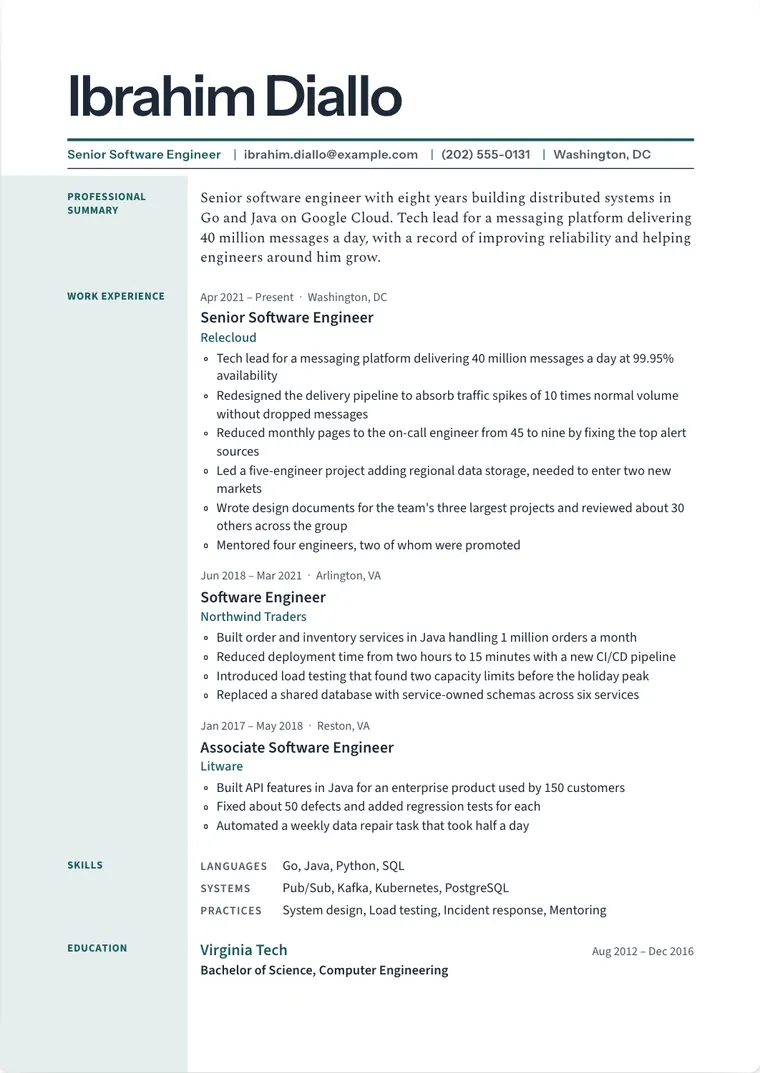
Whatever the role, a reader checks your resume for the six things below. Put them in your summary and your first few bullets.
- Scale
- Requests, users, data volume, systems or team size.
- A measured change
- Faster, cheaper, safer or more used. Say what it was before and after.
- Your own part
- Led, designed, built and contributed mean different things. Use the one that's true.
- Tools in use
- List your stack in skills, then show the main tools working in your bullets.
- Work you can show
- Live products, code, or a project that runs.
- Level
- The systems you own, the teams that build on your work and the people you lead. Name it in your summary line.
Certifications and degrees
Developer and data jobs rarely ask for a certificate. Security, networking, cloud and support job ads often name one. List the one the job asks for first, with the issuer and year. Each role page explains which fit each level and how to show one still in progress.
- AWS Certified Solutions Architect - AssociateAmazon Web ServicesCloud architect, DevOps engineer, site reliability engineer, data engineer, database administrator
- Certified Kubernetes Administrator (CKA)The Linux FoundationDevOps engineer, site reliability engineer, cloud architect
- Microsoft Certified: Power BI Data Analyst AssociateMicrosoftData analyst, BI analyst, BI developer
- Cisco Certified Network Associate (CCNA)CiscoNetwork engineer
- Red Hat Certified System Administrator (RHCSA)Red HatSystems administrator
- CompTIA A+CompTIAIT support specialist
- CompTIA Security+CompTIASecurity analyst, security engineer, penetration tester
- Certified Information Systems Security Professional (CISSP)ISC2Security analyst, security engineer
- OffSec Certified Professional (OSCP)OffSecPenetration tester
- Certified Scrum Product Owner (CSPO)Scrum AllianceProduct owner
- AWS Certified Developer - AssociateAmazon Web ServicesSoftware, backend and full stack developers
- Google Cloud Professional Data EngineerGoogle CloudData engineers
- AWS Certified Machine Learning Engineer - AssociateAmazon Web ServicesMachine learning engineers, data scientists
- Master's in computer science, data science or cybersecurity; MBA or master's in engineering managementYour universitySpecialists and architects (master's); managers and product leaders (MBA, MEM)
Skills shared across these roles
Start here, then add the role-specific skills from its own page. No ratings or bars; list what you can show.
- Languages
- SQL, Python, TypeScript, Java, Go, Bash
- Data
- PostgreSQL, Snowflake, dbt, Airflow, Power BI
- Cloud and delivery
- AWS, Azure, Docker, Kubernetes, Terraform, CI/CD
- Security and operations
- Linux, Access control, Monitoring, Incident response
- Working with people
- Design reviews, Documentation, Mentoring, Stakeholder communication
Questions
Which example should I start from?
The title closest to the job ad, at your experience level. If you're applying one level up, start from that level's example and keep your real titles. Then swap in your own systems, scale and results, and check your skills line matches the tools the ad names, so screening software and readers both find them.
Should a technology resume be one page?
One page suits most people with under about ten years of experience, whatever the role. Staff engineers, architects and managers can use two if every line is relevant. Developers can save space with a short skills block and project links, and infrastructure and security roles by naming the scale of the estate once rather than in every bullet.
How many tools should I list?
List the tools you have used in real work and could explain in detail, grouped by area, with the ones the job ad names first. A dozen well-chosen tools reads better than forty, because a reviewer can see what you actually use. Back the main ones up in your bullets, where the work shows how you used them.
What if I can't share exact numbers?
Much technology work is confidential, so readers expect some figures to be rounded or relative. Describe scale through services, users, teams or regions instead. Security and infrastructure roles need extra care: leave out customer names, unreleased products and anything that could help an attacker, such as unpatched systems or internal network details.
Do personal projects count?
Yes, especially early in your career or when you're changing fields. Describe one project like a job: what you built, how it works and a result, with a link to the code or live site. One finished, deployed project says more than several tutorials or unfinished experiments.
Do I need a certificate?
For most developer and data roles, no; work and interviews count far more. Security, networking, support and cloud roles are different: many employers prefer security analysts with certification, and employers may require administrators to be certified in the products they use. List only what you've earned, with the year.
Is a master's or MBA worth it in tech?
A master's in computer science, data science or cybersecurity suits specialist and architect work, and some employers prefer developers who have one. For management, some organisations require or prefer a graduate degree, in computer science, information technology or business administration. That is where an MBA or an engineering management degree fits. Each role page covers its own case.
How do I show I'm ready for the next level?
Show the scope you already have: systems you own, decisions you made, work other teams adopted and people you mentor. A migration or a shared standard that reached beyond your own team is strong evidence. Keep your real title, open your latest job with those bullets, and cut routine tasks to make room for them.