What employers in this field look for
By Gaurav Sharma. Updated .
Lawyers and legal managers read for a few facts first. Put them in the first lines of your resume.
- Practice area
- Litigation, M&A, criminal defense, family law. Name it in your headline and summary.
- Volume and record
- Trials and outcomes, deals and their size, cases supported, deadlines met. Give your role in each.
- Admission or certification
- Each bar admission and court, with the year, or a paralegal certificate and any certification such as NALA's CP.
- Confidentiality
- Describe confidential clients and deals by type and size. Readers notice when a resume says more than it should.
- Tools
- Westlaw, Lexis, Relativity, iManage, Clio, PACER or the system named in the post.
Licences, certifications and degrees
Lawyers must be admitted where they practise, and states may require continuing legal education to keep the licence. Paralegal certification isn't required, but some employers prefer it. For moving up, an LL.M. helps in specialties such as tax, and an MBA or Executive MBA helps lawyers heading toward general counsel or business roles.
- Bar admissionThe bar admission agency in each stateLitigators, corporate and defense attorneys
- Uniform Bar Examination (UBE) scoreNCBE, through each UBE jurisdictionLawyers seeking admission in another UBE state
- Certified Information Privacy Professional/US (CIPP/US)IAPPCorporate lawyers advising on data, privacy or technology
- Certified E-Discovery Specialist (CEDS)ACEDSLitigators and litigation paralegals
- Certified Paralegal (CP)NALAParalegals, and legal assistants moving into paralegal work
- Certified Legal Support Professional (LSP)NALS (exam currently through school groups only)Legal assistants
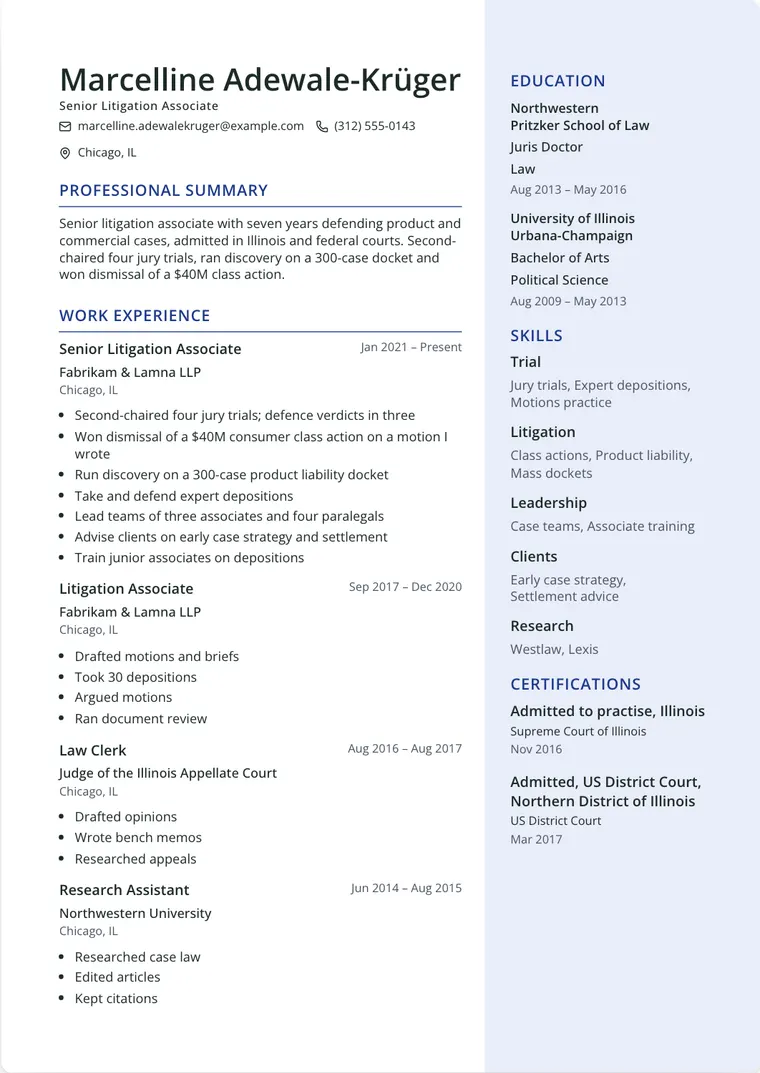
Samples shown in Monochrome Professional, the design you picked
How it looks on the page
The paralegal example's certifications, laid out on the page.
Skills shared across these roles
Start here, then add the role-specific skills from its own page. List skills plainly, with no ratings.
- Legal work
- Research, Drafting, Filings, Deadlines
- Courts and deals
- Motions, Trials, Closings, Due diligence
- Tools
- Westlaw, Lexis, Relativity, iManage, Clio, PACER
- Working with people
- Clients, Partners, Courts, Outside counsel
Questions
Which example should I start from?
The title closest to the job post, at your level. Keep your real job titles, and use the example's structure and bullets as a model for your own work. If you sit between two levels, start from the higher one and cut what you haven't done.
Can I name clients or cases?
Only public cases, or with permission, and only where your firm's rules allow it. Describe the rest by type and size, such as "$40M consumer class action" or "$450M software acquisition". Your duty of confidentiality applies to your resume as well.
Where do bar admissions go?
In their own section near the top, with each state and the year, then the federal courts. Say if an admission is inactive. Readers check this section to see where you can appear, so keep it complete.
Do lawyers need certifications beyond the bar?
Usually not. The licence is what counts, and your record carries the rest. A few certifications help in specific work: the IAPP's CIPP/US for privacy and technology, and ACEDS's CEDS for e-discovery. List one only if it's current and fits the job.
Is an MBA worth it for a lawyer?
It depends on where you're heading. For trial work it adds little. For corporate lawyers, in-house counsel and anyone aiming for general counsel, firm management or a business role, a JD/MBA or Executive MBA can help. List it under Education and say in your summary why it matters.
Paralegal or legal assistant?
Use the title you hold, and describe the work. The two roles overlap. If you draft documents, prepare exhibits or run closings, show it with numbers; that's paralegal work whatever your title.
Should I give my class rank?
Early in your career, if it's strong, along with law review and honours. After about five years, cut it and let your record speak.
One page or two?
One page for most associates, paralegals and legal assistants. Senior lawyers can use two, and many add a separate deal sheet or representative matters list. Keep recent work in full and shrink early jobs.