What employers in this field look for
By Gaurav Sharma. Updated .
HR and operations leaders read for the same few facts. Put them where a quick reader finds them.
- Scope
- Staff you support, roles you fill, spend you manage, loads you move or square feet you run.
- The measure that matters
- Turnover, time to fill, retention, inventory, on-time delivery or cost. Give the before and after.
- Systems
- Name the HRIS, ATS, ERP or WMS. Many posts filter on it.
- Certification
- SHRM, HRCI, ASCM, ISM or WorldatWork. Write it exactly as the issuer does.
- Level
- Employees you support, the sites, spend or budget you run, and the team you lead. Give it in your summary line, next to your title.
Certifications and degrees
None of these roles needs a licence. HR specialists and managers typically need a bachelor's degree, some HR manager jobs require a master's, and certification can help. Credentials follow experience, so list the highest one you hold with the issuer and year.
- SHRM-CP and SHRM-SCPSHRMHR generalists, business partners, managers and recruiters
- aPHR, PHR and SPHRHRCIHR roles at every level
- Certified Compensation Professional (CCP)WorldatWorkCompensation analysts
- CEBSInternational Foundation of Employee Benefit PlansBenefits administrators
- CSCP, CPIM and CLTDASCMSupply chain, logistics and warehouse roles
- CPSMInstitute for Supply ManagementProcurement
- Six Sigma Green and Black BeltASQOperations managers and process roles
- MBA or master's in HRYour universityHR directors, operations and supply chain directors
Samples shown in Axis, the design you picked
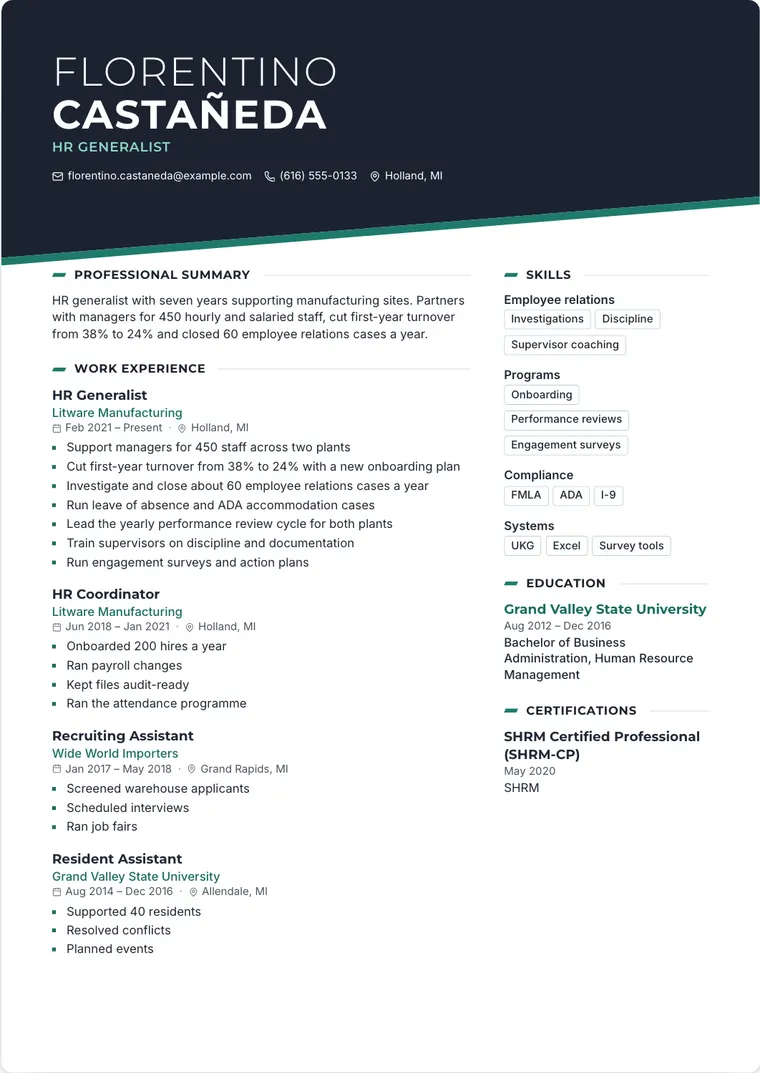
How it looks on the page
The hr generalist example's certifications, laid out on the page.
Skills shared across these roles
Start here, then add the role-specific skills from its own page. List skills plainly, with no ratings.
- Systems
- Workday, UKG, SAP, Oracle, Excel
- Measures
- Turnover, Time to fill, Fill rate, On-time delivery, Cost per unit
- Compliance
- Employment law, FMLA and ADA, OSHA, Customs
- Working with people
- Manager coaching, Supplier relations, Training, Team leadership
Questions
Which example should I start from?
The title closest to the job post, at your experience level. If you're applying one level up, start from that level and keep your real titles. Then swap in your own numbers: employees supported, hires, spend, shipments or sites, each with a before and after.
SHRM or HRCI?
Both are respected, and posts name each. SHRM-CP has no degree or experience requirement and SHRM-SCP suits senior HR leaders. HRCI's aPHR suits people starting out, PHR suits experienced generalists and SPHR suits leaders. Pick the one the posts you want name most.
How do I show confidential people data?
Give volume and results without names or private detail: "handled about 60 employee relations cases a year with no agency charges" or "ran a pay equity review for 3,400 employees". Never share individual pay or case facts. Percentages and counts show the scale without exposing anyone.
Should I list the systems I use?
Yes. Name your HRIS, ATS, ERP, WMS or TMS as the post does, and give one result where you used it, such as a rollout or a report leaders relied on. Posts often screen for the system name.
Which supply chain certification should I get?
ASCM's CPIM suits planners, CSCP covers the wider supply chain and CLTD covers logistics and warehousing. ISM's CPSM suits procurement. List the one that fits your work, with the year, or the exams you've passed.
Do I need a master's or an MBA?
Not to start. Some HR manager jobs require a master's in HR, labour relations or business administration, and top executives of large corporations may hold an MBA. It helps most for director roles in HR, operations and supply chain.
Can I move between HR and operations?
Yes. Hiring, training, scheduling and process work carry across. Lead with results the new role cares about, such as turnover for HR or cost and output for operations, and say in your summary what you're moving into.
One page or two?
One page for most specialists and coordinators. Managers and directors with long records can use two. Keep recent roles in full.