What finance employers look for
By Gaurav Sharma. Updated .
Across these roles, hiring managers read for the same few things. Put them where a quick scan finds them.
- Accuracy you can show
- Clean audits, cleared backlogs, errors found. Name the result and its size.
- Deadlines met
- Month-end close, filing dates, deal timetables. Say how often and how fast.
- The systems you run
- The ERP, modelling or trading tools the job ad names, in the words it uses.
- Licences and progress
- Credentials with issuer and year, or the exam sections passed so far.
- Level
- The book, portfolio, entities or team you own, and the approval authority you hold. Put it in the first line of your summary.
Licences, certifications and degrees
List the one the job asks for first, with the issuer and year. FINRA and state licences decide what you may do; the CPA, CFA and CFP decide how readers place you. Each role page explains which matter at each level and how to word one still in progress.
- CPAYour state board of accountancy (exam by the AICPA)Accountant, CPA, auditor, tax accountant, M&A analyst
- CMAInstitute of Management Accountants (IMA)Accountant
- CIAThe Institute of Internal Auditors (IIA)Auditor, accountant
- EAInternal Revenue Service (IRS)Tax accountant, CFP® professional
- CFACFA InstituteEquity research, portfolio manager, credit and risk analyst, investment banker
- CFP® certificationCFP BoardCFP® professional
- SIE and Series 7, 79, 86 and 87FINRAFinancial advisor, private banker, investment banker, equity research
- Series 63, 65 and 66NASAA (administered by FINRA)Financial advisor, CFP® professional, portfolio manager, investment banker
- FRMGlobal Association of Risk Professionals (GARP)Risk analyst
- CRCProSight Financial AssociationCredit analyst, commercial banker
- CAMS and CRCMACAMS; American Bankers Association (ABA)Compliance officer
- ASA, FSA, ACAS and FCASSociety of Actuaries (SOA); Casualty Actuarial Society (CAS)Actuary
- CPCUThe InstitutesUnderwriter, claims adjuster
- MLO licenceYour state regulator, through NMLSLoan officer
- Adjuster licenceYour state department of insuranceClaims adjuster
- Master's in accounting or finance, or an MBAYour universityAccountants and auditors (master's toward the 150 hours); analysts moving up (master's in finance or MBA); bankers, controllers and CFOs (MBA)
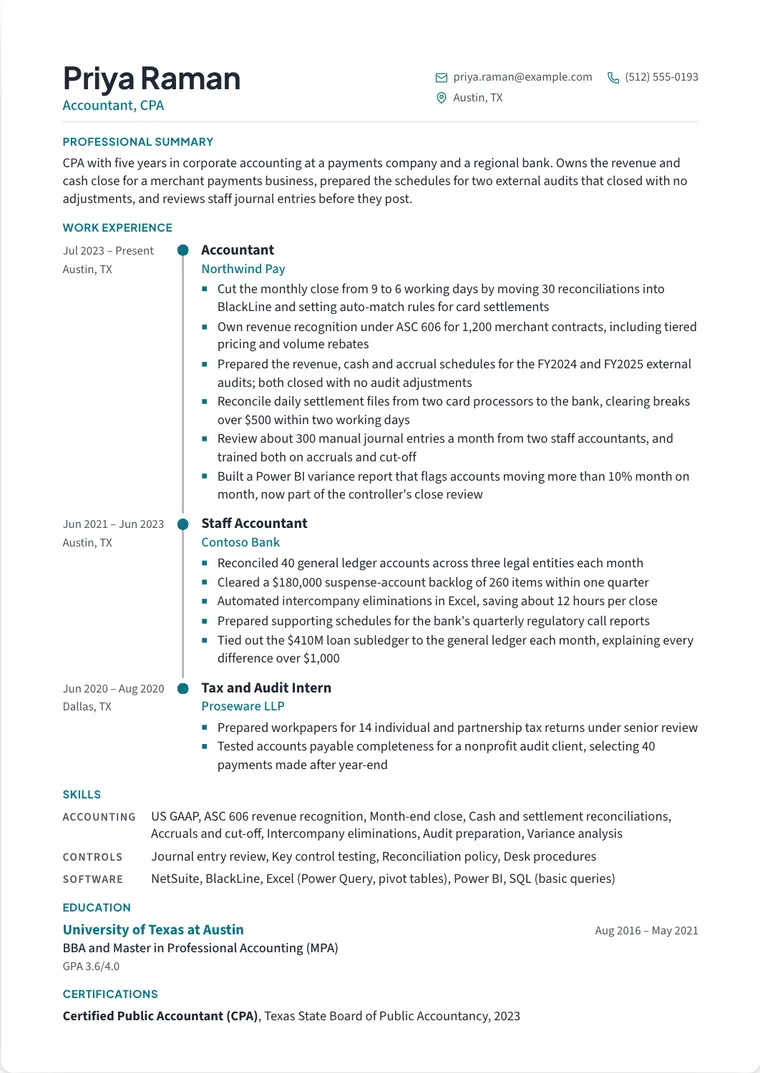
Samples shown in Milestone, the design you picked
How it looks on the page
The accountant example's certifications, laid out on the page.
Skills shared across these roles
Start here, then add the role-specific skills from its own page. No ratings or bars; list what you can show.
- Core finance
- US GAAP, Reconciliations, Financial statement analysis, Variance analysis, Financial modelling
- Controls and compliance
- Internal controls, SOX, KYC and AML, Audit and exam preparation, Regulatory filings
- Software
- Excel, NetSuite, SAP or Oracle, Power BI, Bloomberg, S&P Capital IQ or FactSet
- Working with others
- Explaining numbers to non-finance colleagues, Working with auditors and examiners, Writing memos for committees, Documenting processes
Questions
Which example should I start from?
The title closest to the job ad, at your experience level. If you're applying one level up, start from that level's example and keep your own titles and facts. Then swap in your own clients, deals, portfolios or close tasks, and check that your licences match what the ad asks for.
Is a one-column design better for finance roles?
It reads cleanly in every applicant tracking system and suits conservative employers, which is why most examples here open in one. A two-column design works when your skills and certifications lists are long. Whichever you pick, keep dates, titles and credentials easy to find, because readers check them first.
Should I list an exam I am still taking?
Yes, as exactly what it is: the sections or levels passed and the next one scheduled. Some bodies set the wording. CFA Institute rules out an expected completion date, and CFP Board allows "candidate for CFP® certification" only in applications and resumes. Never put letters after your name before you hold them.
Can I take FINRA exams before I am hired?
Only the SIE, which is open to anyone 18 or older and needs no sponsor. Qualification exams such as the Series 7 and Series 79 need a sponsoring member firm, so list them only once passed. A student with the SIE passed can write "SIE passed, [month year]" in the certifications section.
Investment banker or M&A analyst: which page fits me?
Investment banker covers bank and advisory roles from analyst to VP, working for clients on sales, acquisitions and financings. M&A analyst covers corporate development and transaction advisory, working for the buyer or seller itself. Pick the page that matches who you work for, then borrow deal bullets from the other if they fit.
How do I move from accounting into banking or investment?
Lead with the analysis you already do: models, forecasts, credit or valuation work, and list any CFA levels passed. Audit seniors often move first into transaction advisory or credit roles. Rewrite audit bullets around the numbers you judged, not the tests you ran.
Is a master's or an MBA worth it in finance?
Some employers prefer accountants with a master's in accounting or business administration, and a master's in finance or an MBA may improve a financial analyst's chance of advancing. For licensed roles, the CPA, CFA or FINRA exams usually count first. An MBA helps most for controller, CFO and banking leadership roles.
How do I show I'm ready for a senior finance role?
Show what you own and decide: the close or entities you run, the portfolio or book you manage, your approval authority, and the team you lead. Give one result that moved the business, such as a faster close, a lower loss rate or new clients won.