What employers in this field look for
By Gaurav Sharma. Updated .
Schools, colleges and employers read for a few things first. Put them near the top.
- Who you teach
- Grade, subject, students or staff a year, or the lab you work in.
- Growth
- Reading levels, pass rates, graduation, completion or a business result. Give the before and after.
- Licence or record
- Teaching licence with area and grade band, or papers and grants for research.
- Tools
- Canvas, Google Classroom, MAP, Articulate, R or the lab methods in the post.
- Level
- Classes, caseload, school or programme you lead, and the staff you support. Give it in your summary line, next to your licence or title.
Licences, certifications and degrees
All states license public school teachers, and most license public school principals as administrators. Faculty and research posts depend on degrees instead. Trainers and designers need neither, though ATD's certifications are common. List what you hold with the issuer and year.
- State teaching licenceYour state education agencyTeachers and special education teachers in public schools
- State administrator licenceYour state education agencyPrincipals and assistant principals in public schools
- National Board CertificationNBPTSExperienced teachers, including Exceptional Needs for special education
- APTD and CPTDATDTrainers and designers (APTD, three years) and L&D leaders (CPTD, five years)
- Master's in education leadershipYour universityPrincipals, who typically need one
- PhD or other doctorateYour universityProfessors and research scientists; lecturers at four-year schools
Samples shown in Folio, the design you picked
How it looks on the page
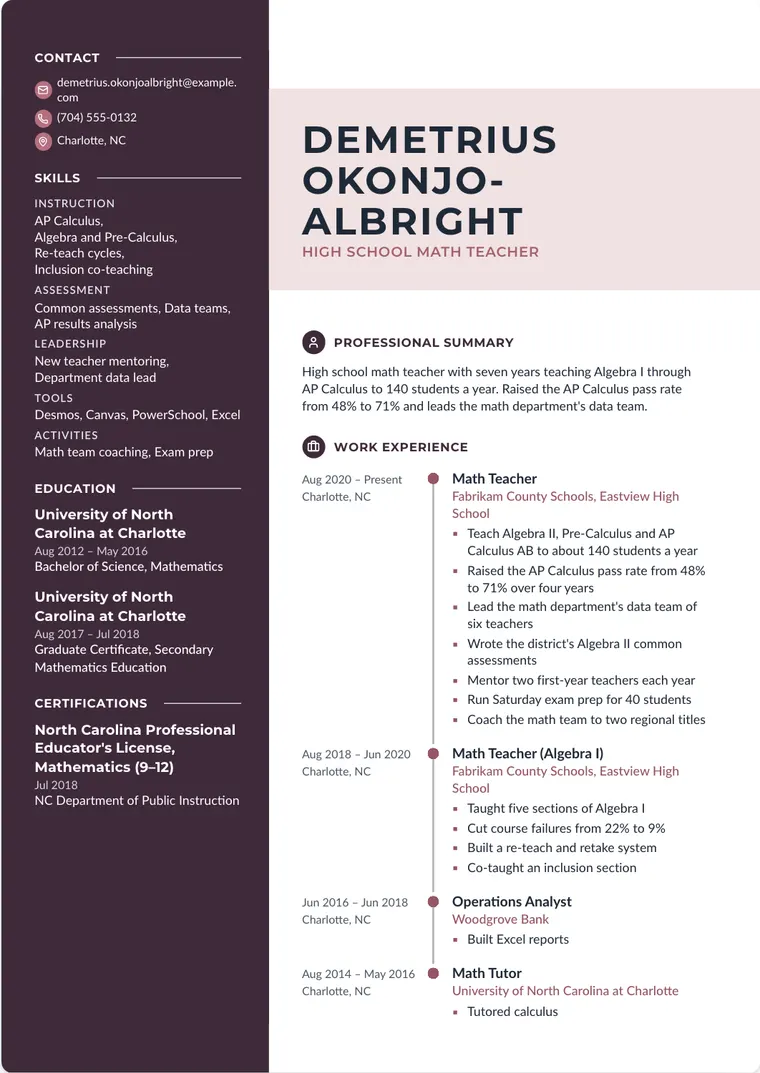
The teacher (k-12) example's certifications, laid out on the page.
Skills shared across these roles
Start here, then add the role-specific skills from its own page. List skills plainly, with no ratings.
- Teaching
- Lesson and unit planning, Differentiation, Assessment, Advising
- Data
- Student data, Pass rates, Learning analytics
- Tools
- Canvas, Google Classroom, Articulate 360, PowerSchool
- Working with people
- Families, Faculty, Subject experts, Managers
Questions
Which example should I start from?
The title closest to the job post, at your experience level. If you're applying one level up, start from that level and keep your real titles. Then swap in your own classes, caseload, programmes or research, and check that your licence or degree matches what the post asks for.
Resume or CV?
Teachers, principals, trainers and designers use a resume of one or two pages. Professors and most academic research posts expect a CV with full lists of publications, grants and teaching. Lecturers at community colleges can often use either, so follow the post.
Where does my licence go?
Near the top, in a licence line or the summary, with its exact name, subject or area, grade band and state. Districts screen for it first. If you're still finishing, give the expected date so a reader knows when you can start.
Do I need a master's?
For principals, usually. Principals typically need one, and some states require teachers to earn one after they're certified. Instructional coordinators in public schools typically need one too. Corporate trainers and designers often don't, though it can help for management roles.
How do I talk about students?
Use numbers and groups, never names or details that identify a child. Give results with the measure your school uses, such as reading levels or IEP goals met. For adult learners, give completion and what changed at work after training.
Can teachers move into training or design?
Yes, it's a common move. Lead with adult-friendly work: training colleagues, workshops, units you designed. Build a short portfolio for design roles, use workplace words such as "learners", and consider ATD's APTD once you have three years in the field.
Is an MBA or doctorate useful in education?
A doctorate is needed for most professor posts and helps for superintendent roles. An MBA helps mostly in corporate learning, where heads of L&D and talent work with budgets and strategy. For teaching and school leadership, a master's in education is the usual route.
One page or two?
One page for most teachers, trainers and designers. Principals and L&D managers often use two. Academic CVs run as long as the record needs.